
Through our relationship with Christ and God’s abundant mercy, we are forgiven and have life eternal
Fourth Sunday of EasterYear A, RCL4/26/2026
Acts 2:42-47Psalm 231 Peter 2:19-25John 10:1-10
Last week, Peter told us of the 3,000 people who joined the church and were baptized. Today, baptism is still the entry into the Church. Anyone who would like to be baptized or become a Christian can be. As we see in our reading from Acts, baptism is not the end of our Christian journey. It’s only the beginning. After the 3,000 were baptized, they devoted themselves to the apostles’ teaching, fellowship, the breaking of bread, and the prayers. We find similar wording in our baptismal and confirmation vows. Yet I wonder whether we intentionally practice these things.
Obviously, if you are here today, you are partaking in the breaking of the bread. For some, this practice is not central to their faith. Some people come on occasion, Christmas and Easter. Others come when it feels convenient. But as Christians, we are called to be in Christian fellowship weekly and, if possible, to have communion as part of this practice.
Fellowship and the prayers go beyond Morning Prayer or the Eucharist on Sundays. Fellowship continues to Coffee Hour (the 8th sacrament, as it’s been called). Fellowship extends to our weekly lives, calling one another, having lunch or dinner together, and checking in on how we can help our Christian family members. This work is not solely the work of the priest. We are one family in which many of you know each other for much longer, even a lifetime in some cases, and this provides you with a deeper connection than any priest could have. Clearly, this doesn’t mean that a priest doesn’t have a role in this ministry, but you can also effectively minister to one another. Who have you not seen at church recently? When did you last check in on them?
Through the biblical text, we witness what the Apostles and the 3,000 had done. We are a part of this narrative, even if you do not find your name written in the pages. I’d imagine that even if you haven’t thought about being part of this story in such direct terms, this may be why some of you are here today. We want to hear your ancestors' stories. We desire to follow in their footsteps. We want to know them better than we already do. For many of us, this way of thinking isn’t that unusual.
We have such feelings within our families. As a child, we’ve heard stories, maybe from a grandparent, and wished we had paid more attention. When our families gather, we enjoy and learn from stories about our parents or distant relatives. Some stories make us laugh, others make us cry, and others help us know who our kin were in ways that bring them to life, making them a part of our lives.
We are connected through stories, through relationships, and through the air we breathe and the water we drink. I’m not being hyperbolic. Scientists have mathematically proven that some of the molecules in the air we breathe and the water we consume are the same ones Jesus breathed and drank. Each time we breathe in and exhale, we move about as many molecules of air as there are stars in the universe.[i] And some of those molecules came from Christ and your ancestors.
We may no longer live in a communal life, as depicted in today’s passage, where the Christians sold all that they had and gave it to the common good, but we do live in a communal life through the walls of this church, where we do love and care for one another. This may be more true for this parish than any other I have served. And I hope you know and feel this love as well.
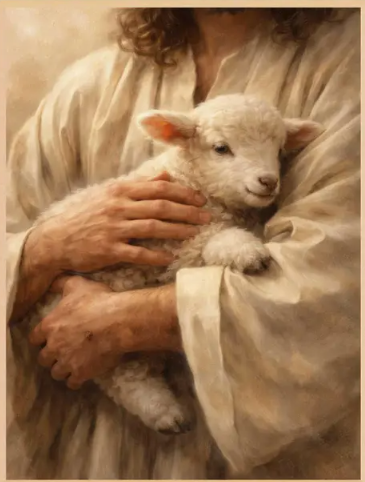
Having a common life together means there are expectations, such as living out the Baptismal Covenant, with God’s help. But this life together also requires a life in Christ, in which we acknowledge that we are among His sheep. We may disagree on how we live out or practice this faith, but I hope that we can agree on what Jesus’ voice sounds like. Jesus says in the Gospel today that His sheep hear His voice and He calls His sheep by name. Since Christ calls us by name, it makes sense that we have differing calls to vocation, ministry, and mission. But the sound of Christ's voice should be the same.
Can someone, who holds up lies as truth, be listening to the same voice that offered the truth, the way, and life everlasting? If we listen to the voice that causes injustice, pain, and suffering, are we listening to the same voice that heals the scuffing, brings light to the injustices, and promises to lead us where pain will be no more? Jesus says to us, that His voice is not the only voice out there. There are the voices of thieves and bandits. He goes on to say that His sheep do not listen to them. “The thief comes only to steal and kill and destroy. I came that they may have life and have it abundantly.”
When we listen carefully, do we really get confused about whose voice we are listening to? Or are we choosing to listen to the voice that tells us what we want to hear? A voice of power and greed. The same voice Jesus heard from the pinnacle of the Temple while in the wilderness for forty days.[ii] This voice, is the voice of the thief or bandit or even satin. This is the voice that soothes our identity, panders to our desires, and does not affirm Jesus’ voice and words. To be fair, it’s not always easy to ignore these other voices.
It may not be as easy as Jesus makes it sound when he is in the paddock with his sheep. Even St. Paul struggled and said, “I do not understand my own actions. For I do not do what I want, but I do the very thing I hate.”[iii] We, like Paul, struggle to follow the way of Christ. Christ’s cross is a heavy burden to carry. But Christ tells us to try and to return to Him. Repent when we fall. Through amendment of life; through faith and an abiding relationship with Christ, Christ will lighten our load.
Through our relationship with Christ and God’s abundant mercy, we are forgiven and have life eternal. This is the story that is told to us through our sacred texts. This is the story that needs to be told to our friends and neighbors. Even though none of us are perfect, and none of us will always get it right, Christ is with us. So in this moment, I ask of you to “go in peace, and pray for me, a sinner.”[iv]
[i] Estimated number of molecules inhaled with each breath = 1.34 x 10^25. Estimated number of stars in the universe = 1 x 10^25.
[ii] Matthew 4:5-7
[iii] Romans 7:15-20
[iv] BCP 448


Comments